
The Journal
Fashion Brand Website CMS DTC Editorial: Store + Content Wins
How a fashion brand website CMS DTC editorial setup — managed by a fashion brand web design agency — lifts AOV, mobile speed, and full-price sell-through.
The Journal
How a fashion brand website CMS DTC editorial setup — managed by a fashion brand web design agency — lifts AOV, mobile speed, and full-price sell-through.
Picture the same shopper, two journeys. On a theme-only Shopify site she taps a paid social ad, lands on a PDP, sees a price, and bounces — there is nowhere to wander. On a fashion brand website CMS DTC editorial setup she lands on a homepage that loads in under a second on her phone, swipes through a SS26 lookbook, reads a 200-word founder note about the mill in Biella, and arrives at the PDP already half-sold. Same product, same price, same ad spend. Wildly different conversion math.
We run Marlowe & Vale out of SoHo and have lived both sides. Two years ago we were a pure Shopify theme with a Linktree journal and a part-time freelancer pushing weekend hotfixes. Today the storefront is still Shopify, but every editorial surface — homepage, lookbooks, journal, store-locator, behind-the-seams series — runs on a managed CMS. AOV is up, return rate is down, we discount less, and we have stopped paying Instagram to rent back our own audience.
If you are scoping this transition and looking for a partner rather than another piece of software to manage, this post is for you. We will walk through what changes when you treat editorial as a first-class surface, when to bring in a managed-change workflow instead of building in-house, and which Workspace CMS features actually move the needle for an apparel catalog. If you would rather see it in motion than read about it, book a 20-minute walkthrough and we will show you the working SS26 build.
The narrative that DTC fashion is finished comes from looking at the wrong cohort. The brands struggling treated their website as a checkout page with a hero banner. They are getting outflanked by Amazon on convenience and by Instagram, TikTok, and Substack on taste. If your only content is a PDP, you have nothing to retain a customer between drops, and nothing to feed the answer engines when a shopper asks Perplexity for an independent label.
The brands quietly compounding — the ones doing 7-figures with frequent capsule releases — share a pattern. Their site is a magazine that happens to sell clothes. Lookbooks ship weekly. The journal has a real editorial voice. By the time a returning customer hits a PDP, she has already spent four minutes on the site this month reading things that were not product pages. That is the engagement that holds full-price sell-through above 70% instead of crashing into markdown season at 45%.
Most of these brands didn't build the editorial side in-house. They paired their storefront team with a small editorial operator — what we'd now describe as a fashion brand web design agency that ships content as well as templates. The difference between a quarterly redesign and a weekly drop cadence is who is on the other end of the ticket queue.
In our experience, 78–85% of fashion DTC traffic lands on a phone, and on cold paid social that tips past 90%. Mobile is the only thing that matters. Yet most Shopify editorial pages — long Liquid templates stuffed with apps — render in 3–6 seconds with cumulative layout shift that throws the hero around as the page settles. A shopper from a TikTok ad does not wait.
A headless CMS layer changes this. Editorial pages render as static documents on a CDN edge. Hero images preload. Type renders before JavaScript hydrates. The experience feels like the brand's own app. On our journal, Largest Contentful Paint sits around 0.9 seconds on a mid-tier Android in New York. Same content rebuilt as a Shopify section ran 3.4 seconds. That is the difference between a 14-second session and a 90-second one — and the long sessions add to cart later that week.
The CMS dashboard surfaces this directly. The Site Speed & Core Web Vitals module runs Lighthouse-grade scoring on every editorial route nightly, flags regressions before a Friday drop, and tracks LCP, CLS, and INP per template. When a new lookbook ships with an oversized hero, we catch it Saturday morning instead of Tuesday when the paid traffic has already bounced. The full SEO and performance toolset sits on the same screen as the editor, so a junior content lead does not have to live in two tabs.
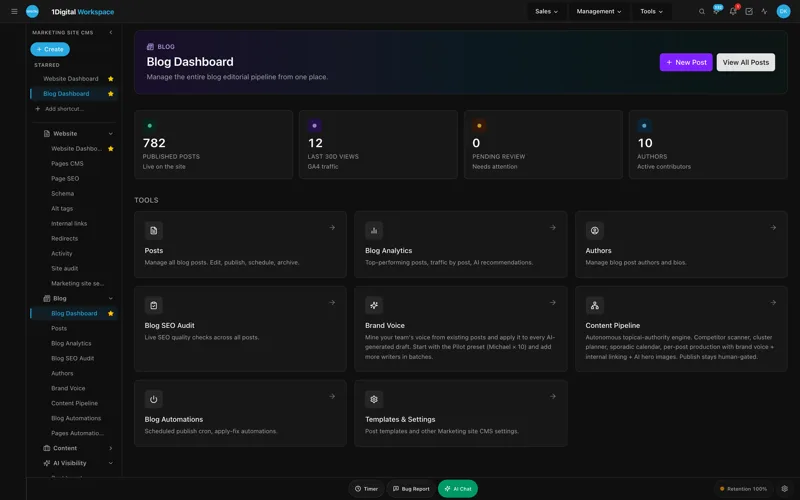
We have used most of the editorial stacks in this space — Contentful, Sanity, the various Shopify section builders, Webflow CMS, half a dozen custom Next.js setups. What follows is the subset of Workspace CMS modules we touch every week. None of them are theoretical; this is the working surface area for an apparel catalog and a journal.
If you want the long version of what each module does, the features overview walks through the full inventory with screenshots.
UNLIMITED MANAGED CHANGES
Send a ticket. We ship the change.
Every Workspace CMS plan includes unlimited managed CMS edits. Essentials ships in 4 business days. Growth ships in 2. Premium ships in 12–24 hours. No per-edit fees. No "open a Jira" overhead. Just describe what you need — every new lookbook page, every drop-week hero swap, every sold-out variant pulled from the homepage, every weekly behind-the-seams post — and our team builds it on your live site.
Shopify collections are flat — a grid, filters, maybe a banner. Fine for basics. A disaster for a brand trying to build a point of view around a drop.
A CMS-led catalog looks different: an "SS26 — The Atelier" page opens with a 60/40 split — left, a portrait video of the seamstress; right, a paragraph about wool sourced from a Prato co-op — followed by an editorial grid where every fourth tile is a still-life or pull-quote. Products pull live from Shopify (inventory, price, variants), so nothing is duplicated, but the framing is editorial. The same SKU appears in three lookbooks across three narrative contexts.
This is the pattern that pushes AOV up. A shopper arriving through the "Cashmere season" lookbook bundles a sweater with a scarf because the lookbook styled them together. A shopper hitting the bare PDP from Google Shopping buys the sweater alone. Same product, +38% basket size in our data. Other brands in this gallery of live demos have rebuilt their capsule pages along similar lines — worth a click if you want to see the pattern across categories.

The uncomfortable truth: if your only on-site update cadence is "new drop every 8 weeks," your customer will follow you on Instagram and never come back between drops. Instagram then owns the relationship, throttles your reach, and rents it back through paid promotion.
The counter-move is a weekly editorial cadence on your own domain. A behind-the-seams post on Tuesday. A founder note on Friday. A re-styled lookbook for the weekend. None of these need new product — they need new framing. The AI Blog Generator and the Content Pipeline Board make this possible without a full-time content lead, and the Internal-Link Rules engine threads every new post back to the relevant lookbook and PDP automatically. Once a week is the floor; once the pipeline is humming, twice is normal.
Here is where most theme-only brands stall. The CMS modules above are powerful, but a founder who is also designing the SS26 capsule does not have the hours to staff editorial production. The choice is either hire — a content lead, a junior designer, a part-time developer — or partner with an operator who handles the build queue while your team handles taste.
What a managed fashion brand web design agency partner actually does on a working week: builds the SS26 landing template Monday, ships two behind-the-seams posts Tuesday and Thursday, swaps the homepage hero for the Friday drop, monitors Core Web Vitals over the weekend, pushes the discount banner Sunday at 10pm when sell-through hits 80%. None of these are "redesigns." They are the editorial ops that keep the site current. We document our managed-change workflow on the marketing site if you want the full mechanics.
For founders who have tried the "hire a freelancer per drop" route and felt the seams — missed deadlines, inconsistent tokens, broken redirects from a developer who has moved on — a single managed partner with a ticket queue and SLAs is the upgrade. Start with a 30-minute strategy call and we will scope what week one looks like for your brand.
The three-tier ladder maps onto stages of a fashion brand, and the right tier depends as much on drop cadence as on revenue. If you are evaluating an apparel website company on price alone, you will pick wrong; pick on cadence.
Compare the ladder in detail on the pricing page. What is shared across all three: real humans, real AI tools, real changes shipped fast. Send a ticket; we ship the change.
Most clients launch in 2 weeks. For a fashion brand migrating off a theme-only setup, week one is: migrate the homepage, journal, and two evergreen lookbooks. Week two: rebuild the SS or FW capsule landing as an editorial collection, ship the first weekly behind-the-seams post, configure the Structured Data Editor with Product schema on PDP embeds and Article schema across the journal, and set up the Redirect Manager with conflict detection so nothing in Google's index breaks. No page-builder fighting. No HTML required. Owner / Editor / Viewer roles plus audit log mean the founder can give the photo intern publishing rights without exposing the homepage. Brands going from Shopify-only to store-plus-editorial generally see the AOV lift inside 60 days; the full-price sell-through lift takes a season.
No. Shopify stays as the commerce engine — checkout, inventory, variants, payments, taxes. Workspace CMS sits in front of and around it as the editorial and SEO layer. Product data pulls through to lookbooks and editorial collections without duplication.
It is prompt-tunable per tenant, and on managed Growth and Premium plans we calibrate it against your existing copy on day one using the Theme & Brand Voice profile. Not a one-click slop machine — a competent first draft you edit, so your team ships in hours, not days.
Design carryover, homepage build, journal template, two collection or lookbook templates, all SEO controls configured, redirects mapped from old URLs, sitemap and llms.txt published, and a working blog with one seeded post. Most fashion clients add a second lookbook template in week three.
When shoppers ask ChatGPT or Perplexity "what's a good independent cashmere brand in New York," you want to be in the answer. The tracker runs your prompts across ChatGPT, Claude, Perplexity, and Gemini on a schedule and flags movements. Combined with the AI Content Audit's one-click fixes, you can move the needle instead of guessing.
On Premium the blocker SLA is 4 business hours. On Growth, blockers are same-business-day. Most launch-night requests — swap a hero, hotfix a sold-out variant, push a discount banner — fall under the blocker definition.
If you are running a DTC fashion brand and you feel the ceiling of a theme-only setup — slow editorial pages, no real journal, lookbooks that take a developer to update — schedule a working session with our editorial team. We will walk through your current site, show you the editorial patterns that move AOV and full-price sell-through, and scope a 2-week launch.
Visit the atelier
Come see the collection in the room where it's made. Private fittings, in-house alterations, and a glass of something while you try the pieces on.
